
Standinghall Estate: specialist kit for High Weald woodland management
27 July 2026
Managing woodlands in the High Weald’s increasingly wet winters is a problem that many landowners will recognise. A Farming in Protected Landscapes Grant has enabled landowners Darren and Effie Phizaklea to purchase specialist equipment to overcome some of the problems on their estate in West Sussex.
Managing woodlands in winter
Coppicing, thinning and felling are traditionally done in winter when the trees are dormant to reduce stress and avoid the bird nesting season. Removing damaged or windblown trees can help reduce the risk of pests and diseases such as European spruce bark beetle. But as winters get wetter, using heavy machinery for management risks causing permanent damage to woodland floors.
Standinghall is an estate of 200 hectares near Crawley in West Sussex – an area rich in history, which was formerly part of one of the High Weald’s four medieval hunting forests. The estate includes 130ha of woodland, a mixture of ancient woodland, hazel and chestnut coppice, PAWS (plantations on ancient woodland sites), conifer and mature native hardwoods.
Problems of winter working
Since taking over Standinghall in 2018, Effie and Darren Phizaklea have focused on improving long-term woodland health, adopting a continuous cover forestry approach that avoids clear-felling and maintains a permanent canopy. However, the site’s steep valleys, irregular layout and heavy clay soils make it difficult to access timber with conventional wheeled forestry machinery, particularly in wet conditions. Previous use of heavy equipment had already damaged soil structure and biodiversity, requiring remedial work and further disturbance.
Effie explains: “Prolonged wet weather from October to April makes using heavy machinery on High Weald clay impossible without causing extensive rutting and damage to the woodland floor. We want to protect our vulnerable woodland soils, but that means we can only carry out very limited works in winter – exactly when canopy thinning and clearance should take place.”
A low impact solution
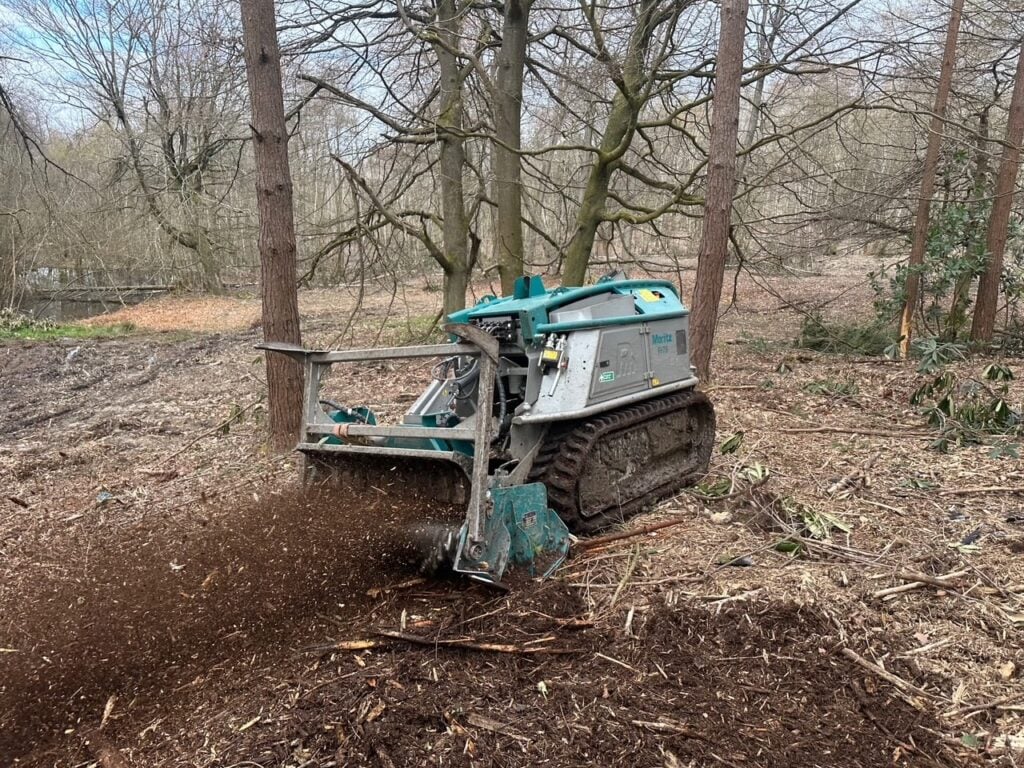
Working with the High Weald team, Effie and Darren identified specialist lightweight tracked equipment as a solution, and a grant from the Farming in Protected Landscapes (FiPL) programme enabled them to purchase a Pfanzelt Moritz FR75 mini felling tractor, imported from Bavaria.
Weighing just 1.5 tonnes, the Moritz has low ground pressure and can operate across sensitive soils and steep terrain. It can carry out multiple tasks, from scrub clearance and access creation to winching and timber extraction, and is small enough to be transported on an 8ft trailer, opening up opportunities for shared use across the National Landscape.
Darren says, “I’m from Cumbria originally, which is obviously very different from Sussex. All landscapes are unique, with their own characteristics and needs. Having the High Weald team’s experience of this particular landscape has been really useful – they could explain what things were like historically, and what we needed to manage or promote.”
Putting it to the test
Shortly after acquiring the machine, the estate was served with a statutory plant health notice following an outbreak of spruce bark beetle. More than 50 acres of spruce had to be clear-felled, including areas in a steep, inaccessible gulley. The new equipment proved critical.
‘A really good relationship’
Describing the impacts of the grant, Darren says: “We were right in at the deep end, but the Moritz really came into its own. Thanks to the FiPL grant we had been able to invest in equipment that works for us: it treads lightly, performs different tasks, reduces damage to the landscape and supports long-term woodland health.
“We ended up with a really good relationship with the team. It’s gone far beyond just applying for funding. Their support with FiPL was fantastic, but more valuable still is having the ongoing contact and expertise. Someone you can check in with, who understands it really intimately. I feel like there’s someone I can pick up the phone to, rather than scratching my head.”
View all news