
Deterring Deer on your Land
20 October 2026
Practical advice for gardeners, allotment holders and anyone with smaller landholdings in the High Weald
Deer are an important part of the High Weald landscape, but record high deer populations are putting pressure on our woodlands, wildlife habitats, farmland and gardens.
The most effective way of managing deer is through a coordinated and humane approach, with landowners and deer managers working together across the landscape to reduce their numbers. However, this isn’t always practicable, particularly in gardens, allotments and other smaller landholdings.
If you are struggling with deer on your land there are several measures you can take to deter them and protect valuable plants and produce.
Deer fencing
Fencing can provide effective protection against deer, although it can be a costly option. Fallow deer are the main species causing problems in the High Weald, and to be effective against them fencing needs to be at least 2.2m high.
Traditional stock fencing can look unsightly in the High Weald’s wooded landscape. It also requires regular maintenance, especially where falling trees and branches may cause damage.
Temporary fencing – made from cheaper plastic – can be useful short-term protection, for example whilst coppice regrows. However, it is prone to breaking. Poorly secured mesh can tear or become entangled around deer and other wildlife, so it should be used with care and checked regularly.
Whatever type of fencing you use it is important to check for gaps and weak points. Deer are very good at finding their way into enclosed areas, and once inside they can find it hard to get out and do a lot of damage.
Dead hedging
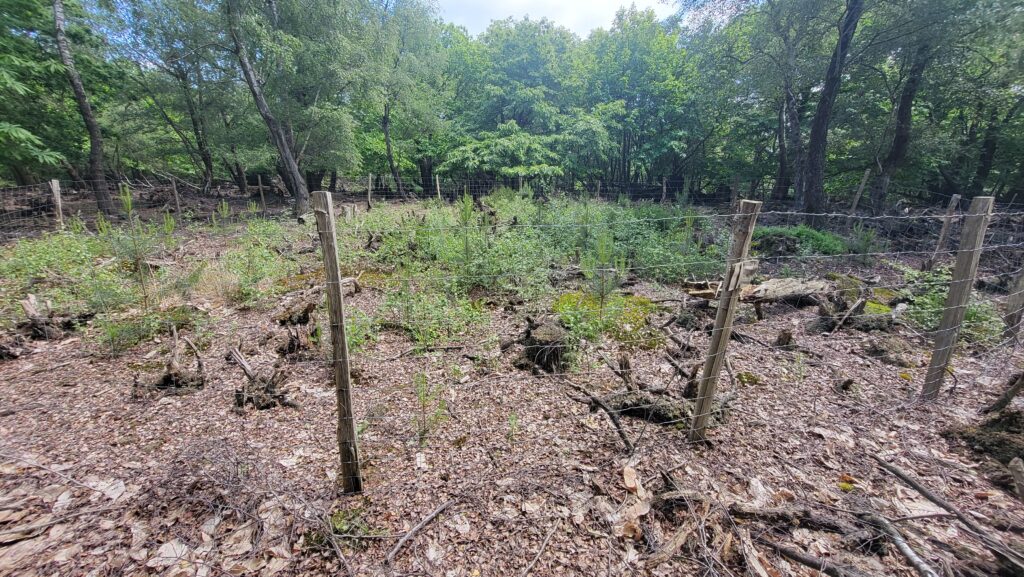
Dead hedging – woody cuttings woven between vertical stakes at a height of 2 metres – is an effective and low-cost traditional alternative to fencing. It is also a great way to use up tree and hedge cuttings, rather than chipping or burning.
Dead hedges are a familiar feature in many of the High Weald’s nature reserves and at National Trust properties. There are plenty of videos on the internet that will show you how to make one. Spiky prunings are particularly useful, and native shrub species such as hawthorn, blackthorn, holly and gorse can help create a dense barrier that is hard to cross.
Dead hedging has other benefits. It provides shelter for hedgehogs and other small animals, and nesting opportunities for birds such as blackbirds, robins, dunnocks and wrens. These and other native species depend on the rich woodland understory which is being increasingly damaged by deer browsing – one of the reasons reducing deer numbers is so important.
Human activity and disturbance
Deer like an easy life. They are seeking a ready supply of food (water is not important to them) and a quiet place to sleep and rest. As a ruminant they eat for four hours and sleep for the next four and so on. Regular human activity can disturb this pattern, and sometimes discourage them from spending time in a particular area.
Walking through your land, gardening, dogs barking and other every day activities can help make an area less attractive to deer. However, deer are quick to learn – they will soon accept even loud noises such as a chainsaw – and learn not to be concerned.
If you have neighbouring landowners who are involved in coordinated deer management it may be worth discussing how your land fits into the wider picture. Timing your disturbance to push deer onto the land where they are actively managed can be helpful.
Choosing deer resistant plants
Deer aren’t picky eaters, but they prefer some plant species over others. Sadly, they are fans of our native bluebell that make our woodlands so beautiful in spring, and of the rare orchids found in our ancient meadows.
In gardens, deer seek out vegetables, young shoots, and ornamental plants such as roses, tulips, hostas and lilies. Although yew are toxic to many animals, deer can devour yew hedges. They are less drawn to aromatic plants such as lavender and mint, to fuzzy or prickly foliage, and to some bulbs such as daffodils and foxgloves, which are toxic to deer.
The British Deer Society offer some excellent advice as to plant choice to minimise deer impact: Deer in gardens – The British Deer Society.
Commercial repellents
Some landowners in the High Weald have reported good results from using commercial repellents to protect vegetables, fruit trees, shrubs and ornamental plants.
Different products work in different ways, often using smells or tastes that deer find unpleasant. Their effectiveness can vary depending on conditions, and we recommend researching products carefully. Always check the manufacturer’s instructions before use, particularly if you intend to treat fruit or vegetables that will be eaten.
The ones we are aware of are listed below. If you have found an alternative repellent that works, please let us know!
Trico deer repellent: available from several suppliers including the British Deer Society https://bds.org.uk/shop/trico-garden-500ml-deer-repellent
Revira deer deterrent: available online https://revira.uk/products/deer-deterrent
Please note: the High Weald team does not have any commercial relationship with these companies or their products. Our objective is simply to raise awareness and to help landowners to manage deer damage.
If you need any advice regarding deer management please email our Deer Management Coordinator: mark.smithCET@highweald.org
View all news